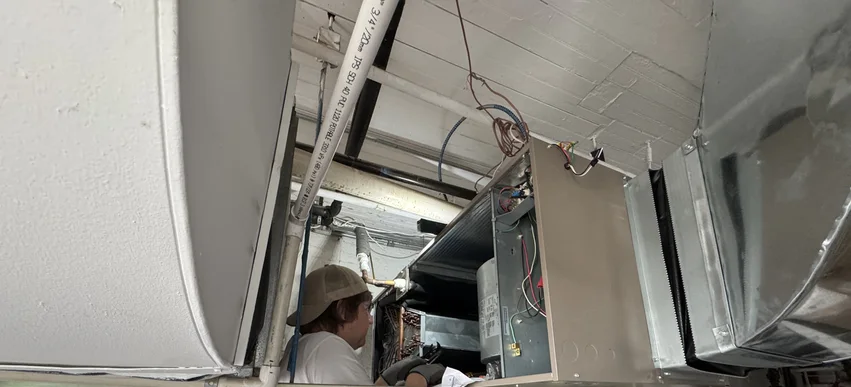
Could a bend in flexible duct explain one room’s weak airflow?
When one room loses airflow immediately after a ceiling repair, tell the building manager what changed and where. Flexible supply duct can be pulled tight around a corner, flattened under stored material or left hanging in a deep loop. The thermostat and the main unit may continue to operate normally while that branch delivers less air.
Compare the affected outlet with its neighbors
With the system operating normally, record which outlets still deliver air, whether the affected register is open and when the difference began. A photo taken through an already accessible service opening can help the installer recognize a disturbed run. Leave ceiling access, dampers and duct supports to the party responsible for the installation. In a co-op, a ceiling void can contain services shared with another apartment.
Ask how the correction will be verified
Correcting a visible sag can be worthwhile, but a smooth-looking outer jacket does not prove the inner liner is fully open. Ask the technician to identify the restricted section, check the connection and compare airflow at the same outlet before and after. If airflow stays weak, the damper, branch sizing or another restriction may need a closer look.
The Building America guide to supporting flexible ducts illustrates how compression and poor support restrict flow. For a residential HVAC assessment, provide the location of the ceiling work and the outlets affected.