Can Installing a Smart Thermostat Extend the Life of Your HVAC System?
Most homeowners assume their HVAC system will last the expected 15 to 20 years based solely on the equipment’s build quality. This assumption overlooks a critical factor: how the system operates daily determines wear patterns far more than manufacturing specifications alone.
The average residential HVAC system cycles on and off between 3 and 8 times per hour during peak demand periods. Each cycle subjects compressors, motors, and electrical components to startup stress—the most damaging phase of operation. Traditional thermostats maintain temperature through simple on-off commands, creating inefficient cycling patterns that accumulate mechanical wear over months and years.
Understanding this relationship between operational patterns and equipment longevity reveals why temperature control technology matters for system preservation. The equipment controlling your HVAC system directly influences how hard that system works, how often it cycles, and ultimately, how long it lasts.
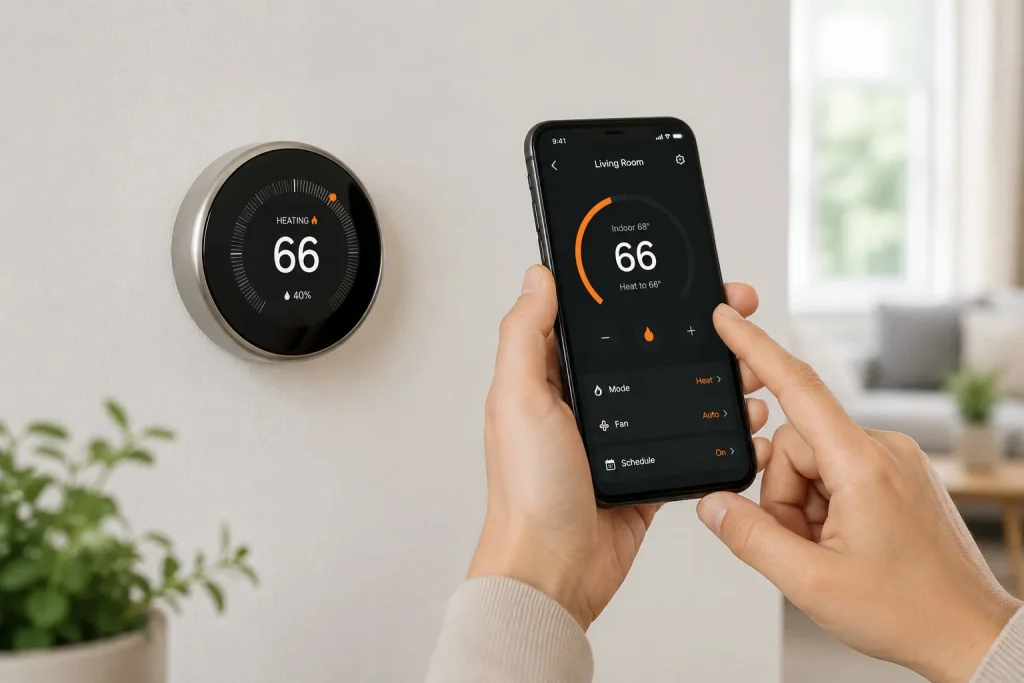
Research and Industry Data Supporting Smart Thermostat Benefits
Evidence supporting smart thermostat effectiveness for system preservation comes from multiple sources. The Environmental Protection Agency’s ENERGY STAR program recognizes certified smart thermostats for their ability to reduce unnecessary heating and cooling cycles while maintaining comfort parameters.
Studies examining smart thermostat performance indicate energy savings between 10% and 23% compared to traditional thermostat operation. While these figures primarily address energy consumption, the underlying mechanism—reduced operational demand—directly correlates with decreased mechanical wear.
Research from the American Council for an Energy-Efficient Economy demonstrates that programmable temperature setbacks during unoccupied periods reduce total system runtime. Smart thermostats automate these setbacks more effectively than manual programmable models, as occupancy detection eliminates the need for precise scheduling.
Field data from HVAC service providers supports these findings. Technicians report that systems paired with smart thermostats often exhibit less component degradation during routine maintenance inspections compared to identical systems operating with conventional thermostats. While this evidence remains observational, the pattern appears consistent across multiple equipment brands and installation environments.
| Factor | Traditional Thermostat | Smart Thermostat |
|---|---|---|
| Cycling Frequency | Higher (reactive only) | Optimized (predictive) |
| Temperature Variance | ±2-4°F typical | ±1°F typical |
| Runtime Optimization | None | Automated scheduling |
| Humidity Management | Basic or none | Integrated monitoring |
| Maintenance Alerts | None | Proactive notifications |
How Smart Thermostats Reduce System Stress and Extend Equipment Life
Smart thermostats protect HVAC equipment through several operational mechanisms that traditional thermostats cannot replicate.
Adaptive Learning and Predictive Operation
Modern smart thermostats analyze heating and cooling patterns to predict temperature requirements. Rather than waiting for temperature to fall outside the set range before activating, these devices initiate conditioning cycles gradually. This approach reduces the temperature differential the system must overcome, allowing equipment to operate at partial capacity rather than maximum output.
Gradual operation particularly benefits air conditioning compressors, which experience less stress when ramping up slowly rather than activating at full capacity. Variable-speed systems paired with smart thermostats can modulate output continuously, virtually eliminating the startup stress associated with traditional on-off cycling.
Occupancy-Based Optimization
Geofencing and occupancy sensors allow smart thermostats to reduce conditioning during unoccupied periods without requiring manual schedule programming. When residents leave, the system automatically adjusts setpoints to reduce runtime. Before anticipated return, conditioning resumes gradually.
This functionality provides two benefits: reduced total operating hours and elimination of unnecessary full-capacity operation. Systems running fewer hours experience proportionally less wear, extending component lifespan accordingly.
Humidity and Air Quality Integration
Advanced smart thermostats monitor humidity levels and coordinate with HVAC equipment to maintain appropriate moisture content. Proper humidity management reduces the workload on air conditioning systems, which must remove moisture as part of the cooling process. Systems operating in properly humidified environments work less intensively to achieve comfort targets.
Some models integrate with air quality monitors to optimize ventilation and filtration cycles, further reducing unnecessary system operation while maintaining indoor environmental quality.
Maintenance Monitoring and Alerts
Smart thermostats track runtime data and can alert homeowners to abnormal operation patterns. Filter change reminders based on actual system usage rather than arbitrary time intervals ensure optimal airflow. Restricted airflow from dirty filters forces blowers to work harder and causes evaporator coils to operate at suboptimal temperatures—conditions that accelerate wear and reduce efficiency.
Early detection of unusual cycling patterns or runtime increases may indicate developing problems before they cause system failure, enabling preventive maintenance rather than emergency repairs.
Can a Smart Thermostat Mess Up an AC Unit?
Proper installation and configuration prevent compatibility issues. Smart thermostats work with most 24-volt HVAC systems, which represent the majority of residential installations. However, certain system types require specific thermostat models or professional configuration.
Heat pump systems, multi-stage equipment, and systems with proprietary controls may require compatible smart thermostat models. Incorrect wiring during installation can potentially damage control boards or cause operational problems. Professional installation eliminates these risks and ensures proper system integration.
mostat models ranging from $150 to $300. However, energy savings typically recover this investment within one to three years, with equipment preservation benefits providing additional long-term value.
How Do You Extend the Life of Your HVAC System?
Smart thermostat installation represents one component of comprehensive HVAC preservation strategy. Maximum equipment longevity requires attention to multiple factors.
Regular professional maintenance remains essential regardless of thermostat type. Annual inspections identify developing problems before they cause system damage. Technicians clean components, verify refrigerant levels, and ensure electrical connections remain secure.
Filter replacement at appropriate intervals maintains airflow and protects internal components. Smart thermostat runtime tracking improves filter change timing compared to calendar-based schedules.
Proper system sizing during installation prevents chronic overwork. Oversized systems short-cycle continuously, while undersized equipment runs constantly. Neither condition promotes longevity.
Ductwork maintenance ensures conditioned air reaches intended destinations efficiently. Leaking ducts force systems to work harder, increasing wear without improving comfort.
Smart thermostats enhance these practices by optimizing daily operation between maintenance intervals. The combination of professional service and intelligent daily management provides comprehensive equipment protection.